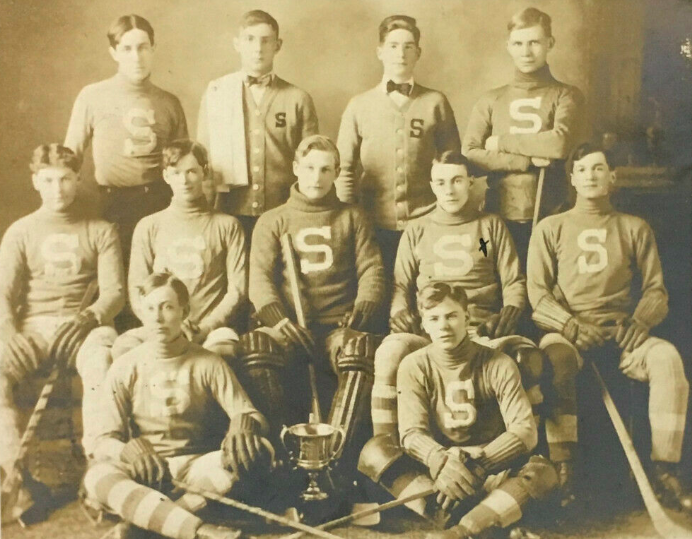
SOO INDIANS
In the winter of 1904, a bold new circuit was born on the frozen border waters of Sault Ste. Marie: the International Professional Hockey League (IPHL), widely regarded as the world’s first fully and openly professional hockey league.
At the heart of this groundbreaking league stood the Sault Ste. Marie Indians, representing the American Soo. Coached and managed by local sporting legend George “Red” Garvey, the Indians played their home games in the cavernous Soo Rink on the American side, while their fierce cross-river rivals, the Canadian Soo Algonquins (later just called the Soo), skated just a few hundred yards away across the St. Marys River.
The Indians’ roster read like a who’s-who of early hockey mercenaries. Stars included:
Fred “Cyclone” Taylor (in 1906–07), already a superstar drawing $1,000 for the season—an astronomical sum at the time.
Newsy Lalonde, the future Hall of Famer who terrorized goaltenders with his blistering shot.
Bruce Stuart and Hod Stuart, brothers who brought size, skill, and legendary toughness from Ottawa.
In their inaugural 1904–05 season, the American Soo Indians finished second with a 14–8 record, led by the scoring of Archie Hooper and goaltender Billy Nicholson. The following year (1905–06), they battled the Portage Lake Huskies (featuring Hockey Hall of Famer Riley Hern) down to the wire for the championship.
The 1906–07 campaign became the stuff of legend. With Cyclone Taylor joining the club mid-season after a contract dispute in Portage Lake, the Indians posted an incredible 19–4 record and claimed the IPHL championship, finishing ahead of the Canadian Soo, Houghton-Portage Lake, Calumet, and Pittsburgh. Taylor’s speed and end-to-end rushes left border-town crowds roaring on both sides of the river.
Though the IPHL folded after the 1907 season due to financial pressures and player raids by emerging Canadian pro leagues, the Soo Indians left an indelible mark. They proved that professional hockey could thrive in small, passionate northern communities and helped launch the careers of several future NHL and Hockey Hall of Fame players.
More than a century later, the name “Soo Indians” still echoes in the rafters of the Big Bear Arena as a proud reminder of the winter when Sault Ste. Marie, Michigan, helped turn hockey from amateur pastime into big-league spectacle.